

Blog
Does THCA Get You High? Complete 2026 Guide

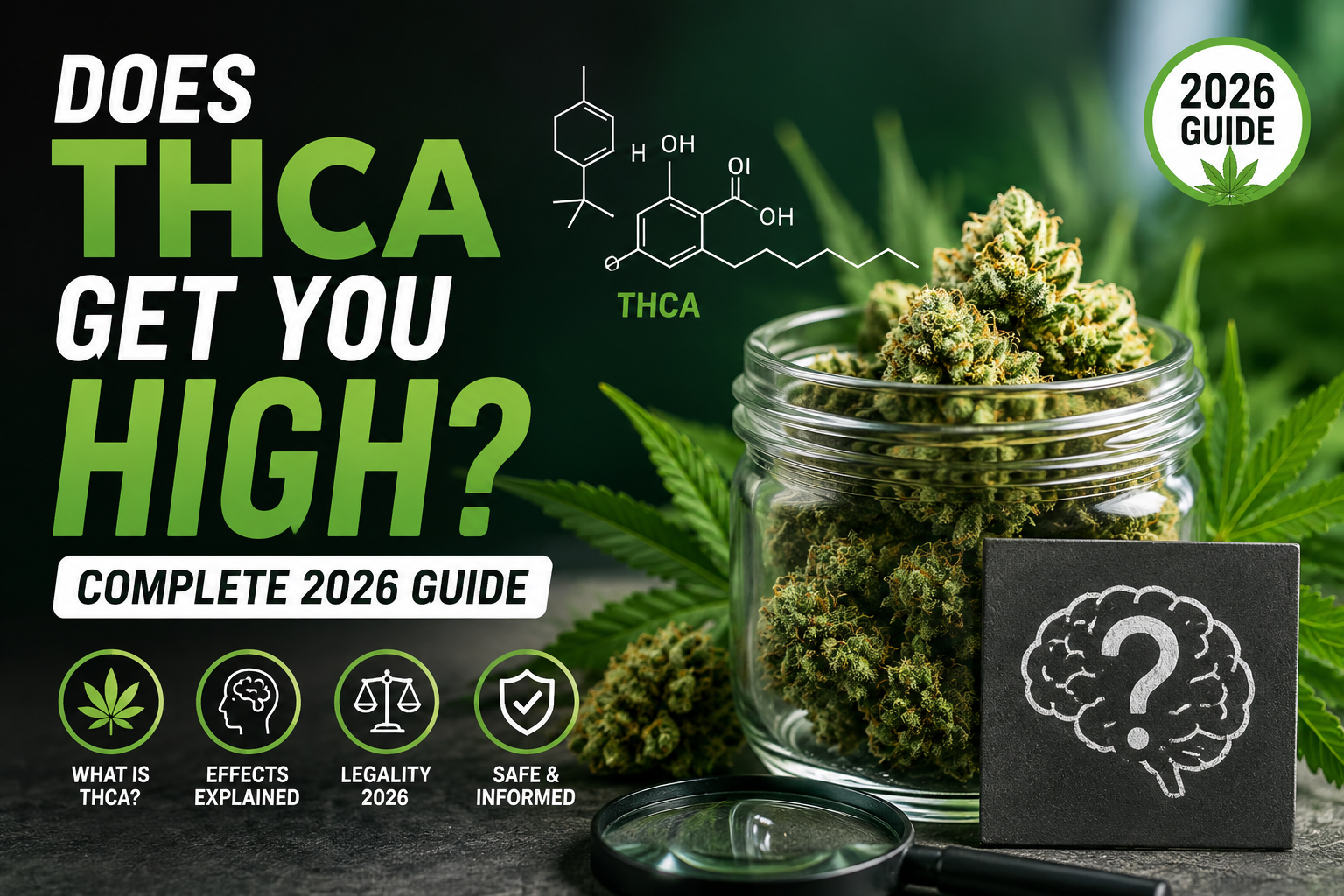
Yes, THCA can lead to a high when it is heated.
Raw THCA is the acidic precursor to THC and is not considered intoxicating in its natural form. When sufficient heat is applied, THCA undergoes a chemical reaction called decarboxylation, converting it into Delta-9 THC. THC is the cannabinoid primarily associated with the intoxicating effects of cannabis.
That means the answer depends largely on how THCA is consumed.
- Raw THCA: generally not intoxicating.
- Smoked THCA flower: heating converts THCA toward THC, producing intoxicating effects.
- Vaporized THCA: heat can also convert THCA to THC.
- Heated/cooked THCA: conversion can occur during heating.
- Unheated products: the experience can be different because THCA has not undergone the same heat-driven conversion.
So if you’re asking, “Will THCA get me stoned?”, the important factor isn’t simply the word THCA on the label. It’s whether the product is exposed to enough heat to cause decarboxylation.
What Is THCA?
THCA stands for tetrahydrocannabinolic acid.
It is a naturally occurring cannabinoid acid found in cannabis plants. In fresh cannabis, cannabinoids commonly exist in acidic forms, including THCA. With heat, these acidic cannabinoids can undergo decarboxylation and form their neutral cannabinoid counterparts.
THCA and THC are therefore closely related, but they aren’t identical compounds.
This distinction is one reason THCA creates so much confusion for new buyers.
You may see a flower advertised with a high THCA percentage and wonder:
“If it contains so much THCA, why doesn’t it already make me feel high?”
The answer comes down to chemistry.
Why Does THCA Get You High When You Smoke It?
When THCA flower is smoked, the high temperatures involved can drive decarboxylation, converting THCA into THC.
THC can interact with cannabinoid receptors in the body’s endocannabinoid system and is the primary cannabinoid responsible for cannabis intoxication.
This is why the same flower can behave differently before and after heating.
Before heating
THCA remains predominantly in its acidic form.
During heating
Heat promotes decarboxylation.
After conversion
More THC becomes available, contributing to the intoxicating effects associated with cannabis.
Read More: How THCA Converts to THC: Science Behind the High
Does THCA Get You High When Vaporized?
It can.
THCA Vaporization involves heating the material, and heat can promote the conversion of THCA into THC.
The exact outcome depends on the product, temperature, device, exposure time, and other factors. Research has demonstrated THCA decarboxylation during heating and vaporization-related processes.
That’s why searching for “does THCA get you high when vaporized” has essentially the same core answer as smoking: heated THCA can produce THC and therefore intoxicating effects.
Does THCA Get You High When Eaten?
This question requires more nuance.
Raw, unheated THCA is not expected to produce the same intoxicating effect as THC.
However, some edible products containing THCA may undergo heating during manufacturing, preparation, or cooking. In those circumstances, some THCA can convert to THC.
So don’t assume that every product labeled “THCA edible” will produce the same experience.
Always check the product’s cannabinoid information and how it was manufactured.
What Does a THCA High Feel Like?
Once THCA has been converted into THC through heating, the resulting experience is associated with THC rather than THCA itself.
People can describe cannabis intoxication in different ways, including:
- Euphoria
- Relaxation
- Altered perception of time
- Increased appetite
- Changes in sensory perception
- Sleepiness
- Increased mental stimulation
- Reduced concentration
The experience isn’t identical for everyone.
Factors such as individual tolerance, product potency, consumption method, cannabinoid profile, terpene profile, and personal sensitivity can all influence how someone experiences THC.
That’s why there isn’t one universal answer to “What does THCA feel like?”
More accurately, heated THCA products can produce an experience associated with the THC generated through decarboxylation.
How Long Do THCA Highs Last?
There isn’t one exact duration that applies to everyone.
Once THCA has been converted into THC, the duration of effects can vary depending on factors such as:
- Route of administration
- Product potency
- Amount consumed
- Individual tolerance
- Metabolism
- Previous cannabis exposure
- Product composition
Inhaled cannabis generally has a faster onset than orally consumed cannabis, while edible products can have a delayed and longer-lasting experience.
So if you’re searching “How long do THCA highs last?“, don’t rely on a single number as a guarantee.
The better answer is:
The duration depends on how the THCA product is consumed and how much THC becomes available through conversion.
Why Doesn’t THCA Get Me High?
If someone uses a THCA product and doesn’t experience intoxication, several explanations are possible.
1. The Product Wasn’t Heated
Raw THCA doesn’t produce the same intoxicating effects as THC.
2. Insufficient Conversion
Not all THCA necessarily converts to THC during a particular heating process.
USDA hemp testing itself accounts for the potential conversion of THCA into THC when calculating total THC.
3. Individual Differences
People have different tolerances and sensitivities to cannabinoids.
4. Product Composition
The advertised THCA percentage doesn’t tell the entire story. The cannabinoid profile, terpene profile, product quality, and method of consumption can all matter.
5. Expectations Are Too High
A product with a high laboratory THCA number doesn’t guarantee that every person will experience the same effects.
How Many Milligrams of THCA Does It Take to Get High?
There isn’t a scientifically established universal “THCA dose to get high” that applies to everyone.
More importantly, THCA itself isn’t equivalent to an orally administered dose of active THC.
Once heat converts THCA into THC, the resulting amount of THC depends on the amount of THCA present and how efficiently the conversion occurs.
Laboratory calculations often use a conversion factor when estimating potential total THC. USDA’s hemp testing framework, for example, accounts for THCA’s potential conversion when determining total THC.
Therefore, a statement such as “X mg of THCA will definitely get you high” would be misleading.
THCA Potency: Why the Percentage Can Be Misleading
Seeing 25%, 30%, or even higher THCA on a laboratory report can make a product appear extremely potent.
But the number needs context.
A COA may list:
- THCA
- Delta-9 THC
- Total cannabinoids
- Other minor cannabinoids
- Terpenes
The THCA percentage represents the amount measured in the product—not a guarantee of the exact amount of THC that a person will experience after consumption.
If you want to compare products, look at the complete Certificate of Analysis (COA) instead of relying only on the biggest number on the label.
Read More: How to Read THCA Lab Reports Like a Pro
Does THCA Show Up on a Drug Test?
THCA products can present a drug-testing concern because heated THCA can convert to THC.
Many cannabis drug tests are designed to detect THC-related metabolites rather than simply looking for unchanged THCA.
Research on cannabinoid testing explains that THC is metabolized into compounds that can be targeted by drug-testing methods.
Therefore, if passing a workplace, athletic, probation, or other drug test is important to you, don’t assume a THCA product is “safe” simply because it is marketed as hemp-derived.
Read More: THCA Drug Test Guide (2026): Will THCA Show Up on a Drug Test?
Is THCA Safe to Smoke?
The phrase “THCA flower” doesn’t automatically mean a product is risk-free.
When cannabis or hemp flower is combusted, combustion produces smoke containing additional compounds. Research has also identified potential contaminants in cannabis products, which is one reason product testing and quality control matter.
If you’re evaluating a THCA product, look for a current third-party lab report that provides information about cannabinoids and contaminant screening.
Also remember that federal hemp rules and state laws are separate from questions about personal health or safety.
THCA vs THC: What’s the Difference?
| Feature | THCA | Delta-9 THC |
|---|---|---|
| Chemical form | Acidic cannabinoid | Neutral cannabinoid |
| Naturally present in raw cannabis | Yes | Present in varying amounts |
| Intoxicating in its raw form | Generally no | Yes |
| Heat changes the compound | Yes | Already in active form |
| Associated with cannabis intoxication | After conversion to THC | Yes |
| Drug-testing concern | Can convert to THC | Yes |
The most important takeaway is simple:
THCA is closely related to THC, but THCA and THC are not interchangeable terms.
THCA vs Delta-8: Are They the Same?
No.
THCA and Delta-8 THC are different cannabinoids.
THCA is the acidic precursor that can convert into THC through decarboxylation, while Delta-8 THC is a different form of THC with its own chemical structure and effects.
Does THCP Get You High?
Yes, THCP is considered intoxicating, but it is a different cannabinoid from THCA and Delta-9 THC.
Don’t confuse the similar abbreviations:
- THCA = tetrahydrocannabinolic acid
- THC = tetrahydrocannabinol
- THCP = tetrahydrocannabiphorol
Each has a different chemical structure and pharmacological profile.
For this reason, an article about THCA shouldn’t treat THCP as simply a stronger version of the same compound.
Does THCA Have Side Effects?
Individual responses can vary, particularly once THCA has been converted into THC.
Potential effects associated with THC intoxication can include:
- Dry mouth
- Increased heart rate
- Drowsiness
- Impaired attention
- Changes in perception
- Anxiety or discomfort in some individuals
If you’re new to cannabis products, don’t assume that a product’s hemp-derived label tells you exactly how it will affect you.
Is THCA Legal in the USA?
This is one area where buyers should be especially careful.
The federal definition of hemp under the 2018 Farm Bill has historically used a 0.3% Delta-9 THC dry-weight threshold, while USDA hemp testing procedures account for the potential conversion of THCA into THC when determining total THC for hemp compliance.
However, federal hemp rules do not automatically mean every THCA product is legal everywhere in the United States.
State laws can impose additional restrictions.
Before ordering THCA online, check the current laws that apply where you live.
Why Are Some People Not Getting High From THCA?
If you’ve searched “why is THCA not getting me high?”, remember that the product label alone doesn’t determine the experience.
Possible reasons include:
- The THCA wasn’t sufficiently heated.
- The product’s actual composition differs from expectations.
- Individual tolerance is high.
- The amount consumed was relatively small.
- The person expected raw THCA itself to be intoxicating.
- The consumption method resulted in different cannabinoid exposure.
The key distinction is between THCA itself and THC produced through decarboxylation.
Does THCA Get You High at All?
Yes, when heated, THCA can convert into THC and produce intoxicating effects.
But raw THCA and heated THCA products should not be treated as identical.
This single distinction answers many of the questions people have about THCA:
Raw THCA → generally non-intoxicating
Heated THCA → conversion to THC → potentially intoxicating
That’s the fundamental concept to remember.
What Should You Check Before Buying THCA Flower?
If you’re shopping for THCA flower online, don’t make your decision based solely on the advertised percentage.
Look for:
1. Current COA
The product should have accessible laboratory testing.
2. Matching Batch Information
The report should correspond to the product you’re purchasing.
3. Cannabinoid Profile
Review THCA, Delta-9 THC, and other listed cannabinoids.
4. Contaminant Testing
Look for testing for relevant contaminants such as pesticides, heavy metals, and microbial contamination.
5. Transparent Product Information
A trustworthy retailer should clearly explain what you’re buying instead of relying exclusively on exaggerated marketing claims.
Read More: How to Verify THCA Lab Results Before Buying
Where Does THCA Come From?
THCA occurs naturally in cannabis plants.
Cannabis plants produce acidic cannabinoid precursors, including THCA. Through the plant’s natural biochemical pathways, THCA develops as part of cannabinoid production.
When heat is later applied, decarboxylation can convert THCA into THC.
That’s why the cannabinoid profile of freshly harvested or unheated cannabis can look very different from the profile of heated cannabis.
Frequently Asked Questions About THCA
Will THCA get you stoned?
Heated THCA can produce a high because heat promotes conversion of THCA into THC. Raw THCA itself is generally not considered intoxicating.
Can you catch a buzz from THCA?
If THCA is heated and converted into THC, it can produce intoxicating effects associated with THC.
Does smoking THCA make you high?
Yes, smoking THCA flower can make you feel high because combustion provides the heat needed for THCA decarboxylation and THC formation.
Does vaping THCA get you high?
It can. Vaporization applies heat that can promote THCA-to-THC conversion.
Do THCA gummies get you high?
It depends on the product and whether THCA was converted to THC during manufacturing or preparation. Don’t assume every THCA edible produces the same effect.
Why doesn’t raw THCA get you high?
Raw THCA is an acidic cannabinoid and doesn’t produce the same intoxicating effect as Delta-9 THC.
How long does a THCA high last?
There isn’t one universal duration. Once THCA has converted to THC, the experience depends on factors including consumption method, product potency, amount, tolerance, and individual response.
Does THCA show up on a drug test?
THCA itself isn’t the same thing as THC, but heated THCA can produce THC, and THC use can lead to detectable THC metabolites. Anyone subject to drug testing should treat THCA products as a potential testing risk.
Is THCA the same as THC?
No. THCA is an acidic precursor to THC. Heat can convert THCA into THC through decarboxylation.
Final Verdict: Does THCA Get You High?
Yes, THCA can get you high when it is heated.
The easiest way to understand it is:
THCA + heat → decarboxylation → THC → intoxicating effects
Raw THCA is different from THC and generally isn’t intoxicating in its natural form. But smoking, vaping, or otherwise heating THCA can drive its conversion toward THC, which is why heated THCA products can produce a cannabis high. Scientific literature supports this heat-driven decarboxylation process.
For buyers, the most important things to consider aren’t just the THCA percentage on a product page. Check the COA, cannabinoid profile, batch information, testing details, product quality, and applicable state laws before purchasing.
Ready to Learn More About THCA?
Explore PottedUSA’s THCA products and educational guides to understand the cannabinoid, compare products, and make a more informed buying decision